The short answer
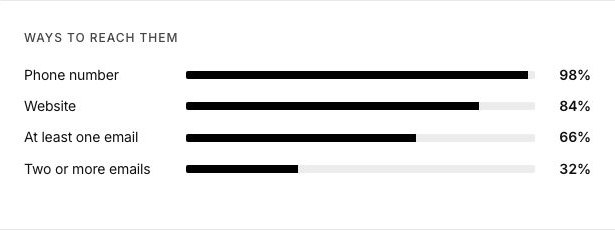
Call small businesses between 10am and 4pm on weekdays, when 85% to 92% of those that list hours are open; at 8am and at 5pm that drops to under half. Across 285,744 businesses in our lists, 95.4% publish a phone number. Dial by hand, ask for the owner by role, and keep your own do-not-call list.
Phone is the one channel almost every small business publishes. Email depends on the industry (see which industries publish email addresses); a phone number is on the listing of nearly every dentist, agent and accountant. The catch is that a small business has one line, one front desk and maybe six hours a day when someone can talk. Calling well is mostly about timing and about getting past that front desk in one sentence.
Which industries you can reach by phone
Phone coverage is high almost everywhere, and highest in licensed professions where the phone is how clients book. Financial advisors (98.5%), dentists (98.3%), real estate agents (98.2%) and accountants (97.8%) nearly all list a number. The gaps are organisations that route calls through a central switchboard or don't staff a line: churches (88.9%) and hospitals (85.4%), where the listed number is often a main line rather than a department.
Share of businesses with a listed phone number, by industry
Every number in our files is in the same form, +1 561-555-0123, so it pastes straight into a dialer. 43.8% of rows also carry a second distinct number in the all_phones column, usually a direct line, a fax or a second location. When the main line goes to a phone tree, try the second number before you try again tomorrow.
When small businesses pick up
We parsed the opening hours on every listing that publishes them (76.7% of rows) and counted how many are open at each hour on an ordinary Tuesday. The curve is a plateau: below half at 8am, about 81% by 9am, 88% to 92% from 10am to 3pm, still 85% at 4pm, then a cliff at 5pm. That plateau is your calling window. Plan the day's list so the hardest calls land between 10am and noon, when the owner has opened up but the afternoon rush hasn't started.
Share of businesses open just after each hour on a Tuesday (local time)
Industries break the pattern in useful ways. Restaurants are open on Saturday (96.4% of those listing hours) but you should never call one at noon or at 6pm; mid-afternoon between lunch and dinner is when a manager can talk. Real estate agents work weekends (75.3% list Saturday hours). Dentists, accountants and financial advisors mostly don't: under 16% of each list Saturday hours. Pharmacies are the one group with a real lunch break: 26.8% of those with hours close for part of the day on Tuesday.
| Industry | Phone listed | Hours listed | Open Saturday | Open Sunday | Best window |
|---|---|---|---|---|---|
| Dentists | 98.3% | 84.0% | 10.3% | 2.8% | Weekdays 10am to 12pm, before lunch patients |
| Real estate agents | 98.2% | 87.0% | 75.3% | 63.1% | Late morning; avoid weekend showing hours |
| Accountants | 97.8% | 77.0% | 15.8% | 5.3% | Weekdays; avoid February to April 15 |
| Restaurants | 95.1% | 95.7% | 96.4% | 81.0% | 2pm to 4pm, between services |
| Car dealerships | 95.8% | 94.1% | 85.7% | 13.8% | Weekday mornings, ask for the general manager |
| Financial advisors | 98.5% | 78.0% | 6.1% | 2.6% | Weekdays 10am to 4pm |
| Churches | 88.9% | 56.6% | 20.1% | 89.0% | Tuesday to Thursday office hours; never Sunday |
A calling workflow that fits a small business day
- 01
Load the list into your dialer or CRM
Import the CSV with phone, business name, city and the hours column. Our CRM import guide has the field mapping.
- 02
Split by time zone and by territory
One state list can span two time zones. Sort by city or ZIP and plan blocks so you call each area in its own 10am to 4pm. See segmenting a list by territory.
- 03
Research each call for 30 seconds
Open the website and the reviews link. One real detail (a new location, a hiring post, a recent review) is your opener.
- 04
Dial by hand, three attempts
Different days and times: Tuesday morning, Thursday afternoon, the next Monday. Leave one live voicemail, on the second attempt.
- 05
Log the outcome the same minute
Connected, gatekeeper, voicemail, wrong number, or do not call. A "do not call" goes on your own suppression list for good.
- 06
Follow up by email the same day
75.2% of businesses with a phone in our files also have at least one verified email. A short note after a call gets read. See cold email for local businesses.
Expect the front desk, not the owner. In a three-person dental office or a brokerage, the person who answers screens every call. Your job on the first call is often only to learn the owner's name and the best time to reach them, then call back. Where our files name the person behind the email (email_name and email_title), you can ask for someone by name; for the rest, ask by role. How to find a business owner's email covers the other ways to get that name.
Short scripts that work at the front desk
Keep each one under 20 seconds. Say who you are, why this business, and ask one question. Never pretend to be a customer or claim a past conversation that didn't happen.
FRONT DESK
"Hi, this is [name] with [company]. Quick one: who looks after
[marketing / the phones / supplies] there? ... Great, is she in today,
or is there a better time to catch her?"
OWNER, FIRST 20 SECONDS
"Hi [first name], [name] from [company]. I'll be quick. I saw
[real detail: your second location in Delray / 200 reviews / the new
hire posting]. We help [industry] offices [one result]. Is that
something you're working on this quarter, or not a fit?"
VOICEMAIL (live, never pre-recorded)
"Hi [first name], [name] from [company], [number]. Calling about
[one-line reason]. I'll send a short email today so you have my
details. Again, [number]."
"NOT INTERESTED" / "TAKE US OFF YOUR LIST"
"Understood, I'll take you off our list now. Thanks for picking up."
-> mark do-not-call in the CRM before the next dial.
US calling rules for B2B calls
Two federal regimes cover sales calls: the FTC's Telemarketing Sales Rule and the FCC's rules under the Telephone Consumer Protection Act (TCPA). Business calls get more room than calls to homes, but not a free pass.
- The Telemarketing Sales Rule mostly exempts B2B. The FTC's business guide says most calls between a telemarketer and a business are exempt from the TSR. Two exceptions: calls to sell nondurable office or cleaning supplies (paper, toner, ink, solvents), and calls to employees at work that pitch products for their own personal use.
- But B2B calls can't mislead. Since the FTC's 2024 amendments, the B2B exemption no longer covers the rule's bans on misrepresentations and on false or misleading statements (16 CFR 310.6(b)(7), which keeps 310.3(a)(2) and (a)(4) in force for calls to businesses). Say who you are and what you sell, and don't invent a prior relationship.
- The National Do Not Call Registry is for consumers. The FTC says the Registry's prohibition doesn't apply to business-to-business calls. The FCC's version of the rule protects residential subscribers and also covers wireless numbers. Many owners of very small businesses list a personal mobile as the business number, so if a number looks like someone's own cell, treat it with consumer-level care.
- Autodialers, pre-recorded messages and texts need consent. Under the FCC rule (47 CFR 64.1200), calls to a mobile number using an autodialer or an artificial or pre-recorded voice need the called party's prior express consent, and prior express written consent when the call is telemarketing. The rule counts a text message as a call. You can't tell a business landline from a mobile by the format, so dial by hand, leave live voicemails, and don't send marketing texts to numbers that haven't opted in.
- Calling hours. The FCC and FTC rules bar telephone solicitations to residential numbers before 8am or after 9pm local time of the person called. Calling a business inside its own published hours keeps you well within that.
- Keep your own do-not-call list. Covered sellers must keep an internal do-not-call list, and the FCC rule says a request must be honoured for five years. Honour every request from a business too; it costs nothing and protects you.
- Show a real caller ID. The TSR requires covered telemarketers to transmit a caller ID number. Use a number that rings back to you.
- State rules exist. The FTC notes that many states also have laws regulating telemarketing, and some keep their own do-not-call lists or registration rules for telemarketers. Check with the attorney general's office of each state you call into.
Email follows different rules; see CAN-SPAM rules for cold email before you send the follow-up. This is not legal advice.
Where to get a calling list
Contact databases built for enterprise sales sell direct dials to employees of larger companies, priced per seat (see LeadLists vs ZoomInfo and LeadLists vs Lusha). For small and local businesses the number that matters is the one on the business's own listing, plus the hours that tell you when it will be answered. Every ready-made list has both for every row, with up to three verified emails for the follow-up, for $29 once. Check the 12 free sample rows first, and if the area or industry you need isn't there, a Bespoke plan builds it to your brief from $99 a month for 2,000 verified leads.