The short answer
Sell to dentists by email first and phone second. Of 11,348 dental practices in our lists, 78.7% publish an email and 98.3% a phone number, but the front desk answers that phone between patients. Write to the owner dentist, copy the office manager, send Monday to Thursday and skip Fridays: only 63% of practices that list hours are open that day.
A dental practice is a small business with a clinical schedule bolted on. The owner is usually a dentist who spends most of the day chairside, and an office manager runs everything else: the phones, the schedule, the vendors, the payroll. Sell to that pair and you sell to most of the market. This guide uses our own files: 7 dentist lists with 11,348 practices, cut by specialty, size, reviews and opening hours.
Who sells to dentists, and what they buy
The buyers of a dentist list fall into a few groups, and each one gets a different first reply. Supply and equipment companies sell consumables, imaging and chairs. Dental labs sell crowns, aligners and dentures. Software vendors sell practice management, imaging, patient reminders and online booking. Marketing agencies sell websites, ads and review programs, which matters because this is a market that lives on reviews: 82.8% of rated practices in our lists sit at 4.5 stars or higher, and the median practice has 82 reviews. Then come recruiters for hygienists and assistants, IT and compliance firms, patient-financing and payment companies, and practice brokers and group buyers looking for owners who want to sell.
| You sell | Who usually decides | Who to reach first | What gets a reply |
|---|---|---|---|
| Supplies, consumables, small equipment | Office manager, within a budget | Office manager | A price on items they already reorder |
| Imaging, chairs, large equipment | Owner dentist | Owner, then office manager | A demo slot outside patient hours |
| Practice software, reminders, booking | Owner, with the office manager's vote | Office manager | Hours saved at the front desk |
| Marketing, websites, reviews | Owner dentist | Owner | Their review count next to a nearby competitor's |
| Staffing and recruiting | Owner or office manager | Office manager | A named, available hygienist or assistant |
| Practice sales, group buyouts | Owner dentist only | Owner, by email | Discretion and a short, plain note |
Who decides at a dental practice
At an independent practice the owner dentist signs anything large and the office manager controls the path to them. The titles in our files show the same split. Where a practice publishes a title next to an email, the most common single title is office manager, ahead of owner and dentist. Treat the office manager as the buyer for anything under a few hundred dollars a month and as the gatekeeper for everything above it.
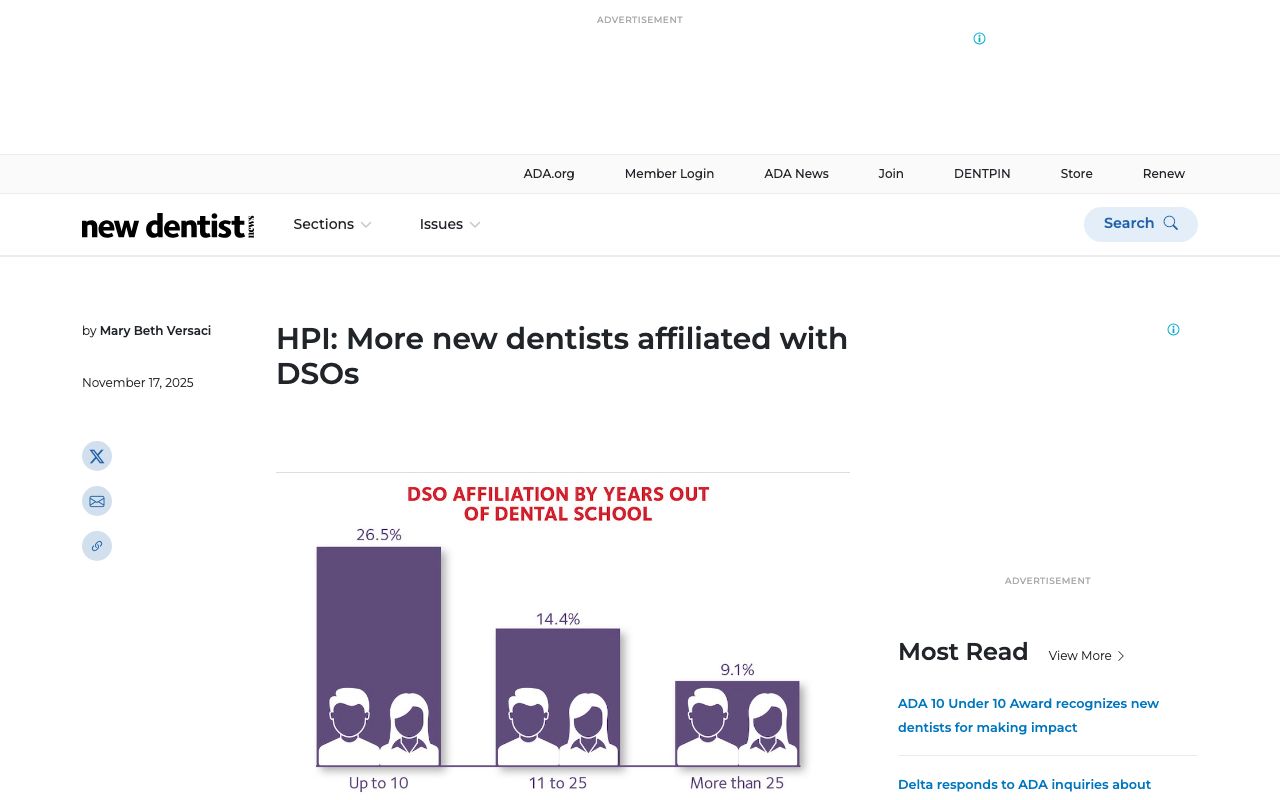
Group practices are the other half of the market. In our files, 35.6% of practices share their website domain with at least one other location. The biggest shared domains belong to multi-location groups such as aspendental.com (159 locations in our lists) and midwest-dental.com (93). The ADA's own research shows where this is heading: in 2024, more than one in four dentists up to 10 years out of dental school were affiliated with a dental support organization (DSO). A DSO location rarely buys software or marketing on its own, so for those rows find the regional or central contact and pitch once for many offices.
One-location practices vs groups sharing a domain
One location (own domain)Domain shared by 2+ locations
One more difference: single-location practices have a median of 189 reviews, group locations 50. The independent owner has usually been in the same spot for years and knows every patient. Lead with something local and specific; a group manager wants numbers across locations.
What dentists publish: the contact data
Dental emails are shared inboxes more often than average: 34.6% of first emails are a generic address, against 19.6% across all our lists. info@ is the first email for 22.6% of practices with one, office@ for 5.5% and frontdesk@ for 2.6%. Free-mail addresses are 16.6% of emails, mostly Gmail. That shared inbox is read by the front desk, which is fine if your message is written for them to forward. See info@ versus personal addresses for when to look for the owner's own email, and how to find a business owner's email for the methods.
Busier practices publish more. In the seven lists, a practice with 200 or more reviews has an email 94.2% of the time; one with no reviews, 42.0%. The same pattern holds across our whole catalogue (more reviews, more emails). Claimed listings tell the same story: 89.2% of practices that claimed their listing have an email, against 42.7% of those that haven't.
Dental practices with a published email, by review count
Specialists are the easiest to email. Orthodontists and pediatric dentists publish an email more than nine times in ten, general dentists about three times in four. If your product fits specialists, start there and your bounce-free reach goes up before you write a word.
Email rate by specialty (listing category)
The best channel: email first, then the phone
Almost every practice has a phone (98.3%), but the person answering is checking in a patient and has a schedule open on the other screen. A cold call that opens with a pitch gets "leave your number." Email reaches 78.7% of practices and gets read at the start of the day, when the office manager clears the inbox before the first patient. Use the phone to confirm who decides and to follow up on an email they have already seen. Reps who sell supplies and lab work still walk in, often with lunch for the team; that works when you already cover the territory. Facebook (67.2%) is the main social channel, Instagram (32.7%) a distant second, so social is for research, not for the first touch.
A four-touch sequence for a dental practice
- 1Email the ownerTuesday, early. Copy the office manager or send to the shared inbox.
- 2Call two days laterAsk for the office manager by role, mention the email.
- 3Second emailOne new fact about their practice: reviews, a new location, a gap.
- 4Visit or close the loopDrop in if you cover the area; otherwise a short last note.
Keep the volume per inbox low and the copy short. Our cold email guide covers sending setup, and cold calling small businesses covers getting past the front desk. Every cold email you send in the US has to follow CAN-SPAM: a real address, a clear way to opt out, no misleading subject.
When to reach a dental office
Dentists keep short weeks. Of the practices that list opening hours, 44.1% are open four weekdays or fewer, and Friday is the day they drop. Only 63.1% open on Friday at all, and of those open both Thursday and Friday, 56.9% close earlier on Friday. The median practice opens at 8:00 and closes at 5:00 on a Tuesday; 28.9% open before 8:00 and only 8.7% stay open past 6:00.
Dental practices open on each day of the week
So: send email so it arrives before 8:00 on Tuesday, Wednesday or Thursday, and call mid-morning or mid-afternoon on the same days. A Friday email sits unread until Monday at more than a third of practices. A call after 5:00 reaches voicemail almost everywhere.
Two templates that work on dental practices
Subject: {practice}'s front desk

Hi Dr. {last_name},

Your practice has {review_count} reviews at {rating} stars, more than most
in {city}. Offices at that volume usually lose hours a week to reminder
calls and confirmations.

We automate that for {n} practices in {state}. Setup takes one afternoon
and your front desk keeps the current system.

Worth 15 minutes with you or your office manager next week?

{your_name}
{company}, {address}
Reply "no" and I won't write again."Hi, this is {your_name} with {company}. I sent Dr. {last_name} a note on
Tuesday about appointment reminders. I don't need the doctor. Who looks after
the front-desk software there? ... Great. Is there a better time than this to
reach them, or should I email them directly?"Objections you will hear, and answers
- "Send me some information." Say yes, then ask one question so the email has a reason to be read: "Is the doctor or the office manager the one who'd look at it?"
- "We already have someone for that." Ask what they would change about it. Dental vendors are sticky; you are often pitching the renewal, not the switch. Ask when the contract ends and write it down.
- "Corporate handles that." That is a group location. Thank them, ask for the regional office name, and check the list for other rows on the same website domain.
- "The doctor is with a patient." They always are. Ask when the doctor checks email, or for the last hour of the day.
- "We're too busy right now." Offer a time outside patient hours. Many practices start before 8:00, so a 7:30 call is a real option.
If you sell only to independents, filter out shared domains before you start. If you sell to groups, sort by domain and treat each group as one account. Either way, segment by territory so a rep can follow an email with a visit.
Building the list yourself is possible; our guide to building a local business lead list walks through it, and buy vs build does the math. Compare the options against Apollo, Data Axle and Outscraper, or see pricing.