The short answer
Sell to real estate agents by email and Instagram, and time it to the slow season. Of 24,483 agents and brokerages in our lists, 77.6% publish an email and 43.5% an Instagram account, both above the average across our 323 lists. Pitch the agent for their own marketing and the broker for office-wide tools, and plan big pushes for November to January, when NAR says activity slows.
Real estate is one of the easiest industries we cover to reach and one of the hardest to hold attention in. Agents answer their phones, publish their emails and post daily, because their business is being findable. They also get pitched all day by every lender, photographer and lead-gen company in town. This guide uses 20 of our real estate agent lists, 24,483 agents and offices, cut by category, reviews, email domain and opening hours.
Who sells to real estate agents, and what they buy
Two kinds of seller work this market. Referral partners want the agent's clients: mortgage lenders, title and escrow companies, home inspectors, insurance agents, movers and cleaners. They are not selling a product so much as asking to be the name the agent gives a buyer. Vendors sell the agent something: listing photos, video and drone, staging, signs and print, CRM and website tools, transaction coordination, coaching, and leads. A third group, brokerage recruiters, sells the agent a new office.
| You sell | Who decides | What they care about | Open with |
|---|---|---|---|
| Mortgage, title, inspection (referrals) | The agent | Closing on time, client experience | How you protect their closing date |
| Photos, video, staging, signs | The agent, per listing | Turnaround and price per listing | A sample from a listing near theirs |
| CRM, websites, lead tools | Agent, or broker for the office | Leads that turn into closings | One number: response time or conversion |
| Office-wide software, training | Broker or owner | Agent retention and compliance | What it saves the office per agent |
| Recruiting to a brokerage | The agent | Split, support, brand | A plain comparison, sent privately |
Who decides: the agent, the team lead or the broker
A real estate list mixes three kinds of row. In the 20 lists, 55.9% of rows are listed as a real estate agency and 38.8% as an individual real estate agent, with consultants and commercial agencies making up the rest. An agency row can be a one-person brokerage, a team or a franchise office with 80 agents. The titles published next to emails show how personal this market is: realtor is the most common, then owner, real estate agent and broker.
Large brands show up through their email and website domains. kw.com is the most common business email domain in the file (3.9% of first emails), and Keller Williams office or agent sites host 565 of the websites. RE/MAX (250 websites), eXp, Compass and Coldwell Banker domains come next. An agent on a franchise domain still picks their own photographer and lender. The franchise matters when you sell tools: many offices already get a CRM from the brand, so ask what they use before you pitch a replacement.
Split the list before you write. Commercial real estate agencies are a different sale: fewer, larger deals, and an email rate of 85.4% in our files against 75.1% for individual agents. Brokerage offices are where office-wide tools and recruiting pitches go. Individual agents are where referral partners and listing vendors win. The listing itself tells you who is active: 90.1% of rows have claimed their listing, and 80.2% of claimed rows have an email, against 53.3% of unclaimed ones. Put unclaimed listings with no reviews at the end of the sequence: they are the least likely to have an email to send to.
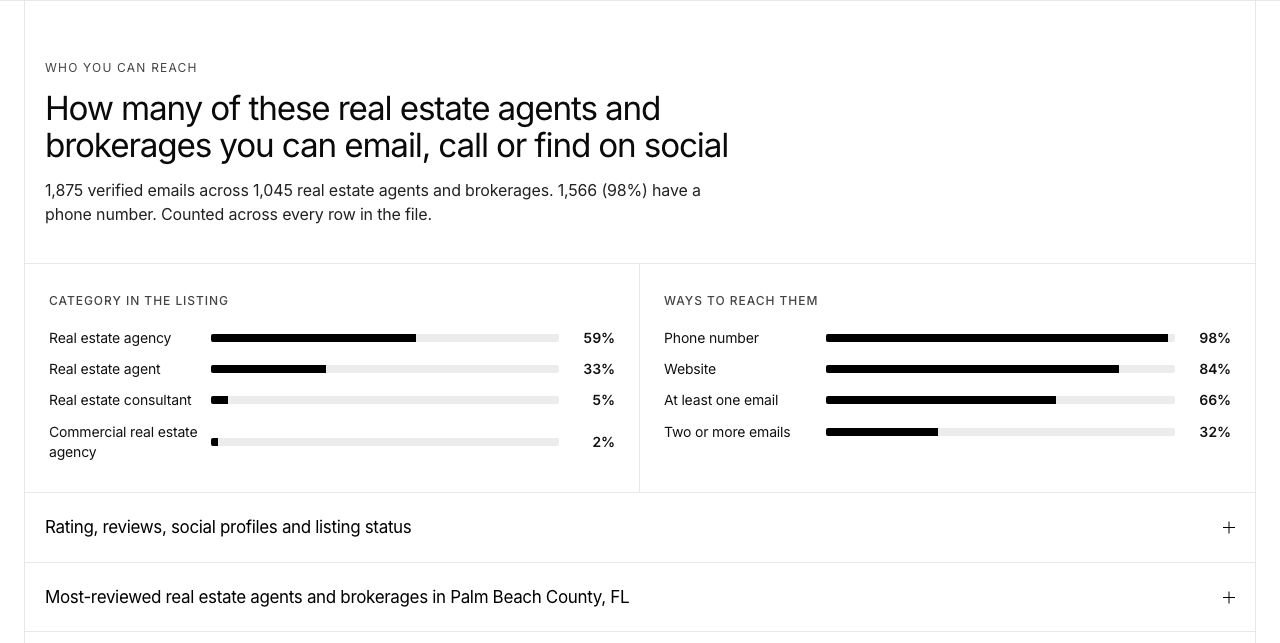
Two numbers stand out. 87.2% of first emails are not a shared inbox such as info@, office@ or hello@, so your email usually lands with the agent, not a front desk. And 21.3% of emails are free-mail, mostly Gmail (16.0% of all first emails), because many agents keep a personal address that follows them from brokerage to brokerage. That Gmail address is often the best one in the row. Our guide to info@ versus personal addresses explains how to rank them.
The best channel: email, then Instagram, then the phone
Email works because agents publish real, personal addresses and read them on their phones between showings. Reviews predict it here as everywhere: an agent with 50 to 199 reviews has an email 90.5% of the time, one with none 57.0%. The median agent has 13 reviews, so most of the list sits in the middle. Two in three are on a website domain no other row in the list uses, and 90.9% of those publish an email.
Agents and brokerages with a published email, by review count
Instagram is the channel that sets this market apart. 43.5% of agents and offices in our lists link an Instagram account, more than restaurants and far more than accountants. Agents post listings, open houses and closings there, which gives you a reason to write that isn't generic: comment on the listing, then email. Social media prospecting covers the method.
Businesses that link an Instagram account, by industry
The phone (98.2%) is often the agent's own mobile, and they pick up because it might be a client. That makes calling effective and also easy to burn: one bad cold call and you are blocked. Call after an email, keep it under a minute, and read the calling rules in cold calling small businesses before you dial mobiles.
A sequence for agents
- 1Look at their listingsOne current listing or recent sale to mention.
- 2Email the agentPersonal address first, short and specific.
- 3Engage on InstagramA real comment on a listing post, same week.
- 4Call onceReference the email, ask one question.
- 5Follow up after their next listingA new reason to write.
When to reach agents: the week and the year
Agents work when clients don't. Of the offices and agents that list hours, 75.3% are open Saturday and 63.1% Sunday, and 25.7% list themselves as open 24 hours. The median listed Tuesday runs from 8:00 to 7:00, and 55.4% stay open past 6:00. That means weekend mornings are showing time and weekday mornings are desk time: send email early on a weekday and call in late morning, before afternoon showings.
The year matters more than the week. The National Association of Realtors notes that pending sales rise in March and peak in June, while November through January is the slowdown. An agent in June has no time for a new CRM. An agent in December is planning next year, reviewing what they spent and open to a call. Run your biggest push from November to February, and in spring sell only what helps close deals faster.
Two templates for real estate agents
Subject: {listing_street} photos

Hi {first_name},

Saw your listing on {listing_street}. Nice house, and the kitchen shots
do it justice.

I shoot listings in {city}: photos, a short video and a floor plan,
delivered next morning. If you have another one coming up this month,
I'll do the first one at my cost so you can compare.

{your_name} · {phone}
{company}, {address}
Not useful? Reply "stop" and I won't email again.Subject: closing on time in {city}
Hi {first_name},
I'm a loan officer in {city}. I know the worst week of a deal is the
one where the lender goes quiet before closing.
My team sends the agent a status update every Tuesday and Friday until
the file closes. Could I be your backup lender for the next buyer who
isn't pre-approved yet? Happy to meet for 15 minutes in January.
{your_name}, NMLS #{nmls}
{company}, {address} · reply "stop" to opt outObjections you will hear, and answers
- "I already have a lender / photographer / title company." Every agent does. Ask to be the backup for when that one is booked or slow, and stay in touch through the slow season.
- "My brokerage gives me that." Ask what they like and don't like about it. Franchise tools are often used by few agents in the office; the agents who outgrow them pay for their own.
- "I'm with a client." Agents mean it. Ask for a time, put it in your calendar, and call exactly then.
- "Leads are all junk." If you sell leads, don't argue. Offer a small trial with clear terms or a number they can check.
- "How did you get my number?" From their own listing or website. Say so plainly and offer to email instead.
One practical step before you send: agents at the same brokerage often share an office inbox, and some rows list a brand portal as the website. Sort by email and domain, keep the agent's personal address where there is one, and import the list into your CRM with the brokerage as the account.
To check any list before you buy it, run it through the lead list quality checklist. To compare sources, see LeadLists vs ZoomInfo, vs Apollo and vs Outscraper, or browse all ready-made lists.