The short answer
CAN-SPAM lets you cold email US businesses without prior consent, but every commercial email must have honest headers and subject line, identify itself as an ad, include your valid postal address, and offer an opt-out you honour within 10 business days. The FTC says the law makes no exception for business-to-business email. Each violating email can cost up to $53,088.
Most cold email to US businesses is legal. The CAN-SPAM Act is an opt-out law: you don't need permission before the first email, but you must follow a short list of rules in every message and stop when someone asks. People get into trouble by skipping the boring parts, like the postal address or a working unsubscribe, not by sending cold email as such.
This guide follows the FTC's own compliance guide for business, quoted where the wording matters. It covers the US rules first, then the main differences in Canada, the UK and the EU, because a list of "local businesses" can easily cross a border.
Does CAN-SPAM apply to B2B cold email?
Yes. The FTC is direct about it: the law covers all commercial messages, and "the law makes no exception for business-to-business email." A commercial message is one whose primary purpose is the advertisement or promotion of a commercial product or service. The FTC also notes that the Act "doesn't apply just to bulk email": a single, hand-written sales email to one dentist counts.
It also makes no difference what kind of address you write to. A shared info@ inbox, a named person on the company domain and an owner's Gmail account are all covered the same way. Here is what that mix looks like in real small-business data.
Messages that are purely transactional or about an existing relationship (an invoice, a warranty notice, account changes) are largely exempt, but the FTC reads that narrowly. A follow-up that mixes an order update with a pitch for a new product is judged by its primary purpose, which the subject line and the placement of the content decide.
The seven CAN-SPAM requirements
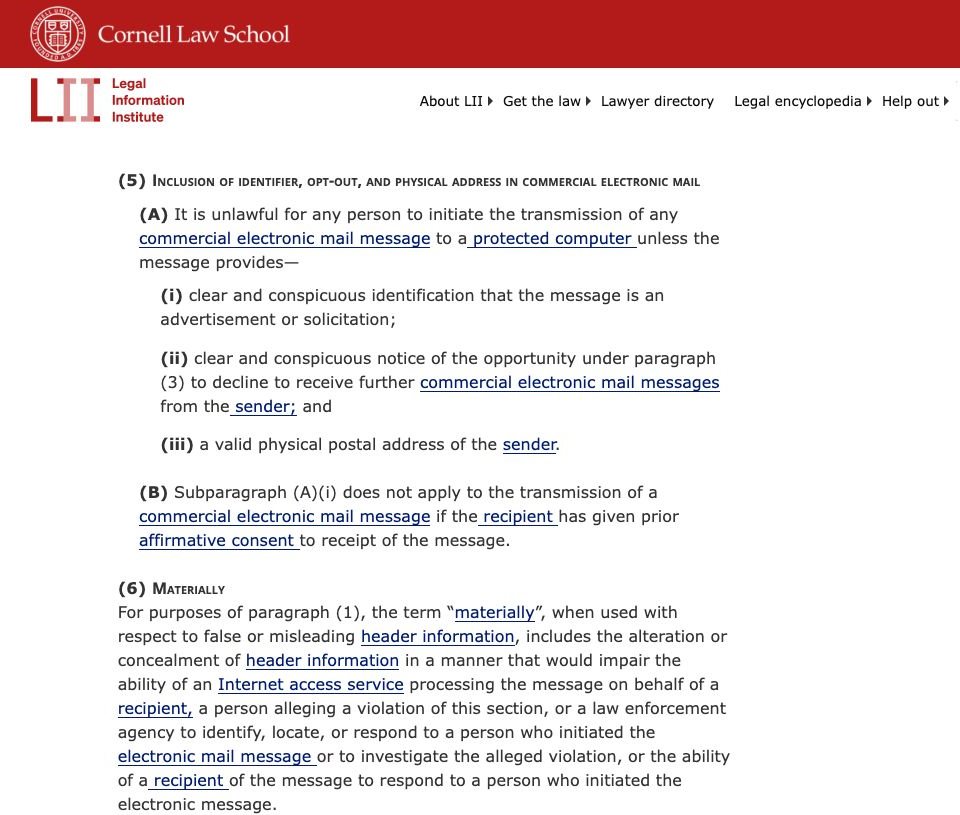
These are the FTC's main requirements, in plain terms. They apply to every commercial email you send, including the follow-ups.
- 01
Don't use false or misleading header information
The From, To and Reply-To fields and the routing information must be accurate and identify the person or business who initiated the message.
- 02
Don't use deceptive subject lines
The subject must reflect the content. "Re: our call" when there was no call is the classic violation.
- 03
Identify the message as an ad
The FTC says you must disclose this clearly and conspicuously, and that "the law gives you a lot of leeway in how to do this."
- 04
Tell recipients where you're located
Include a valid physical postal address: your street address, a US Postal Service post office box, or a private mailbox registered with a commercial mail receiving agency.
- 05
Tell recipients how to opt out
Give a clear and conspicuous explanation of how to stop future email from you, easy for an ordinary person to recognise, read and understand. A return email address or "another easy Internet-based way" both work.
- 06
Honour opt-outs promptly
Process requests within 10 business days. The opt-out must work for at least 30 days after you send. You can't charge a fee, ask for more than an email address, or require more than a reply or a visit to one web page. You can't sell or transfer the address of someone who opted out.
- 07
Monitor what others do for you
If an agency or a tool sends on your behalf, both of you can be held responsible. The FTC says you "can't contract away your legal responsibility."
Penalties, and the violations that cost more
Per the FTC, each separate email in violation of the law is subject to penalties of up to $53,088. A sequence of four emails to 500 businesses is 2,000 emails, so the exposure adds up fast. More than one party can be liable: the company whose product is promoted and the company that sent the message.
The Act adds extra penalties, and in some cases criminal ones, for aggravated violations. The ones that matter to list builders are harvesting addresses by automated means from a website that says it won't share them, and generating addresses with a "dictionary attack" (trying jsmith@, jdoe@, jbrown@ on a domain until something sticks). Other aggravated violations include sending through someone else's computer without permission and registering accounts or domains with false information.
A compliant cold email checklist
- From name and address are real. Your name or your company's, on a domain you control. Replies reach a monitored inbox.
- Subject line matches the body. No fake "Re:" or "Fwd:", no invented urgency.
- It is clear the email is a sales message. A plain, honest pitch usually does this on its own; don't dress it up as a personal favour or an invoice.
- Your postal address is in the footer. Street address, registered PO box, or a registered private mailbox.
- There is a simple opt-out. "Reply 'no' and I won't email again" plus a one-click link if your tool supports it. It must keep working for 30 days after the send.
- Opt-outs are processed within 10 business days. In practice, the same day: suppress the address in every sequence and every tool.
- Opt-out lists are kept, not deleted. Load your suppression list before every import so a removed address never comes back from a new list.
- The list was built from published addresses. Not harvested from sites that forbid it, not generated by guessing at scale.
--
[Your name], [Company]
[Street address or registered PO box], [City], [State] [ZIP]

This is a sales email. Not interested? Reply "no" and I won't
email you again, or unsubscribe here: [link]
Two more rules come from the mailbox providers rather than the law. Gmail requires senders of more than 5,000 messages a day to support one-click unsubscribe for marketing mail and to set up SPF, DKIM and DMARC. Even below that volume, set up SPF or DKIM on your sending domain. Our cold email playbook covers sending volumes and warm-up.
Canada (CASL), the UK and the EU
CAN-SPAM is the most permissive of the major laws. If any of your recipients are outside the US, the rules change, mainly around consent and around whether the recipient is a company or a person.
| US: CAN-SPAM | Canada: CASL | UK: PECR and UK GDPR | |
|---|---|---|---|
| Consent before the first email | Not required (opt-out law) | Required: express or implied | Not required for companies and LLPs under PECR; required for sole traders and some partnerships |
| Cold email to a published business address | Allowed with the rules above | Implied consent if the address is conspicuously published, with no "no unsolicited messages" statement, and the message is relevant to the person's role | Allowed to corporate subscribers; UK GDPR applies if the address identifies a person |
| Identify yourself | Yes, plus postal address | Yes, with contact details | Yes; you must not disguise or conceal your identity |
| Unsubscribe | Honour within 10 business days | Honour within 10 business days; the mechanism must stay valid for 60 days | Provide a valid address for opt-outs and honour objections |
| Maximum penalty | Up to $53,088 per email | Up to $1,000,000 per violation for an individual, $10,000,000 for any other person | Set by the ICO |
Canada: CASL
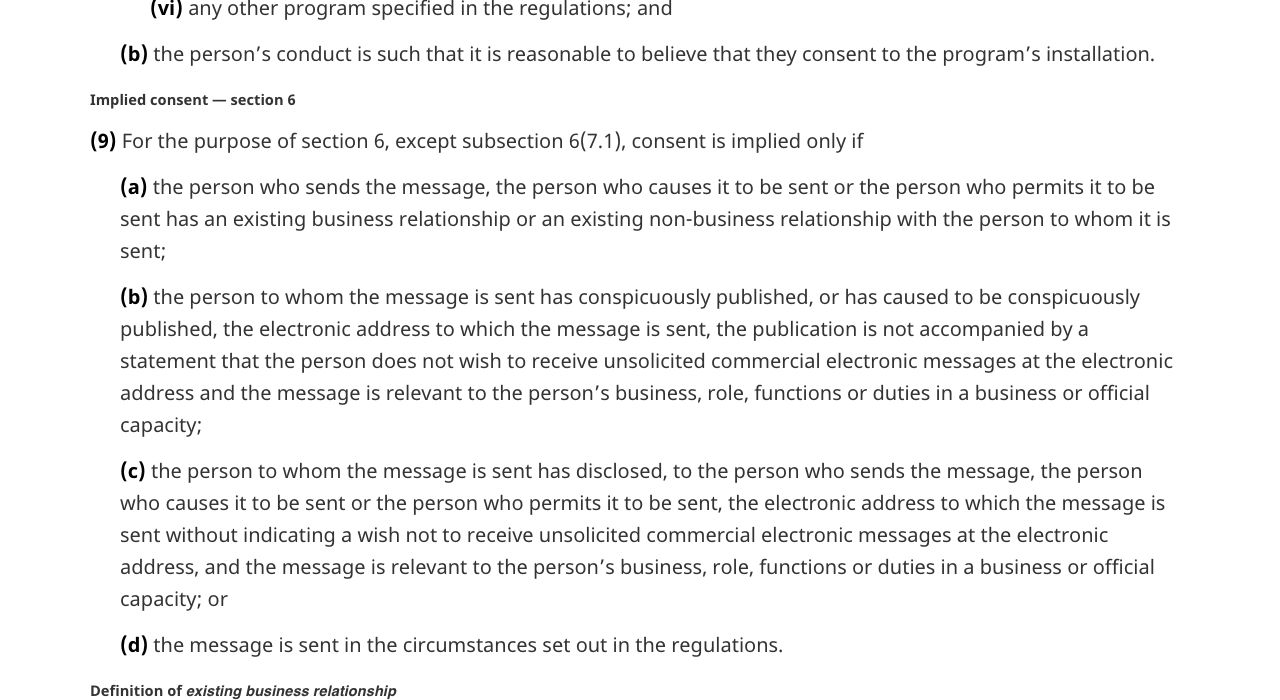
Canada's Anti-Spam Legislation needs consent before you send a commercial electronic message. The useful exception for cold outreach is section 10(9)(b): consent is implied when the recipient has conspicuously published the address, the publication doesn't say they don't want unsolicited messages, and your message is relevant to their business role. Every message must also identify you and include an unsubscribe mechanism.
UK: PECR and UK GDPR
The ICO splits recipients in two. Companies, LLPs and government bodies are "corporate subscribers": you can email them without consent, but you must identify yourself and give a valid address for opt-outs. Sole traders and some partnerships are treated as individuals and need consent or the soft opt-in. And when an address identifies a person (jane.smith@company), UK GDPR applies too: you need a lawful basis, usually legitimate interests, and must respect their right to object. The ICO notes this guidance is under review after the Data (Use and Access) Act.
The company-or-person question is not academic. Owner-run trades often publish a personal Gmail or Yahoo address instead of a company one, which is a good sign the business is a sole trader. In our US data the share of businesses whose best address is free mail runs from 1.4% for colleges to 44.1% for car dealerships. If you build a UK list in these trades, check every free-mail row: it may well be a sole trader, and those rows need consent.
Best address is free mail (Gmail, Yahoo...), by industry
EU: GDPR and national ePrivacy rules
GDPR applies to named business contacts across the EU. Recital 47 says direct marketing may be regarded as a legitimate interest, and Article 21 gives every person an absolute right to object to direct marketing. Whether you need consent for B2B email is set by each country's ePrivacy rules, and some member states require it even for business addresses. Check the country before you send.
Our ready-made lists are US businesses only, so CAN-SPAM is the law that applies to them. Every email in them was published on the public web, most of them on the business's own website or Facebook page.