The short answer
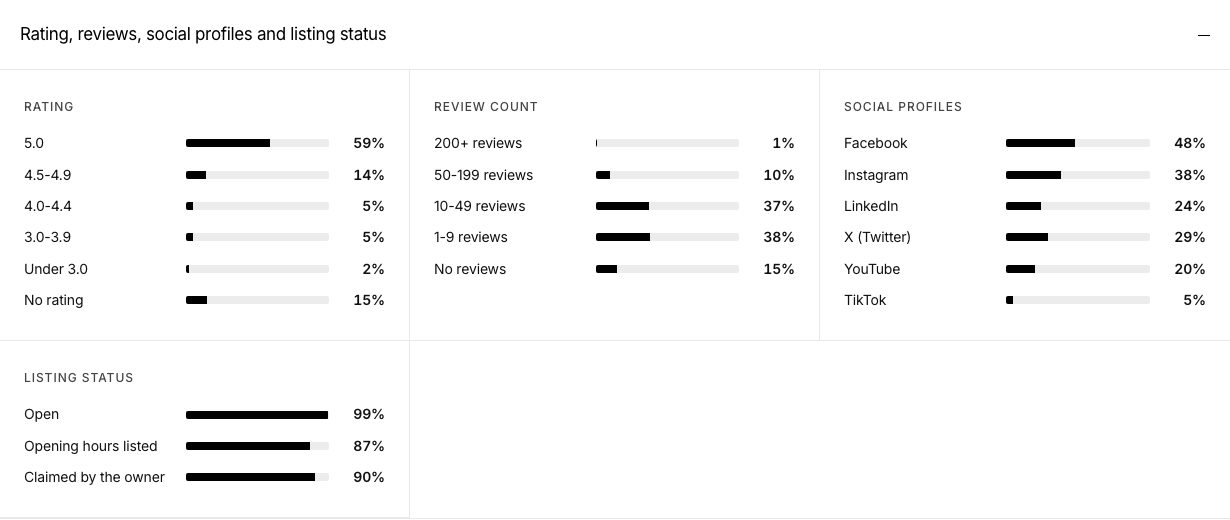
Facebook is the network local businesses use most: 56.8% of the 285,744 businesses in our lists link one, against 39.8% for LinkedIn, 38.4% for Instagram and 6.2% for TikTok. LinkedIn leads for financial advisors, architects and oil and gas companies; Instagram leads for gyms. Use social profiles to research and warm up a prospect, then reach them by email or phone.
Most advice on social selling is written for reps selling to people at large companies, where LinkedIn is the whole game. Local businesses are different. A dental office, a roofer or a restaurant runs a Facebook page and maybe an Instagram account, and the owner may be the one posting. To find out which networks matter for which industry, we counted the social profile links in every row of our 323 lists: profiles found on the business's own website and listing.
Share of local businesses with a profile on each network
A business that has one network usually has several: those with any profile link an average of 3.17 of the six. TikTok is still rare outside a few consumer industries. A link is not the same as an active account, so open the profile before you count on it; a footer icon can outlive the account by years.
Which industries are on which network
The split follows who the business sells to. Consumer-facing businesses lean to Instagram; professional services lean to LinkedIn. Facebook is the most common network in almost every industry, but LinkedIn overtakes it for financial advisors (67.2%), architects (44.2%), medical device makers and oil and gas companies, and Instagram overtakes it for gyms (64.6%).
LinkedIn vs Instagram, by industry
LinkedInInstagram
| Industry | X | YouTube | TikTok | Any | |||
|---|---|---|---|---|---|---|---|
| Plastic surgeons | 82.3% | 72.6% | 46.5% | 51.1% | 41.3% | 14.1% | 88.2% |
| Hotels | 75.4% | 69.5% | 65.6% | 65.9% | 57.7% | 30.0% | 78.3% |
| Financial advisors | 66.2% | 30.1% | 67.2% | 53.3% | 40.7% | 0.8% | 75.3% |
| Advertising agencies | 63.2% | 51.9% | 58.8% | 42.7% | 19.8% | 5.4% | 72.8% |
| Mortgage brokers | 66.6% | 50.8% | 52.2% | 43.4% | 26.3% | 7.9% | 72.6% |
| Gyms | 64.0% | 64.6% | 42.7% | 40.1% | 35.3% | 18.9% | 71.6% |
| Dentists | 67.2% | 32.7% | 26.9% | 25.3% | 14.4% | 3.6% | 70.9% |
| Law firms | 61.8% | 29.7% | 39.4% | 36.2% | 19.2% | 4.1% | 68.8% |
| Real estate agents | 56.1% | 43.5% | 30.0% | 32.8% | 24.4% | 8.1% | 62.1% |
| Roofers | 56.8% | 32.5% | 29.1% | 21.9% | 15.2% | 3.5% | 60.3% |
| Churches | 51.0% | 24.6% | 11.8% | 18.2% | 24.8% | 0.8% | 55.1% |
| Commercial contractors | 44.9% | 22.4% | 29.7% | 14.9% | 6.8% | 2.1% | 54.3% |
| Restaurants | 46.5% | 38.9% | 18.8% | 20.8% | 6.1% | 6.7% | 52.4% |
| Car dealerships | 43.1% | 15.6% | 11.3% | 16.9% | 14.1% | 1.5% | 47.5% |
| Accountants | 32.1% | 10.3% | 27.9% | 15.5% | 4.5% | 0.6% | 41.3% |
| Beauty salons | 32.4% | 32.2% | 18.8% | 17.6% | 8.5% | 11.6% | 40.1% |
| Auto repair | 28.8% | 16.0% | 12.0% | 10.9% | 4.1% | 1.9% | 32.4% |
Social profiles add depth, not reach
The obvious hope is that social profiles reach the businesses you can't email. Our data says that mostly isn't true. Profiles are linked from the same websites that publish emails, so the businesses with a Facebook page are largely the same ones with an email. Of the businesses in our files with no email, only 8.2% have a social profile. Across all rows, 2.2% have a social profile and no email, and almost none have a profile with neither an email nor a website.
There are exceptions where social does fill a gap. Among plastic surgeons without an email, 37.9% still link a social profile; for dermatologists it's 20.5% and law firms 17.1%. Many of these put their marketing into Instagram and Facebook and take enquiries through website forms. For everyone else, treat social profiles as research and as a second touch, and plan on email and phone for the first one. If a business has neither, the phone is still on 95.4% of rows (see cold calling small businesses).
How to use a social profile in outreach
- 01
Check the business is active
Open the Facebook or Instagram link. A post in the last month means an owner or manager who is paying attention; nothing for two years is a signal to call rather than write.
- 02
Find one specific detail
A new hire, a second location, an award, an event, a complaint they answered well. It becomes the first line of your email or the opener on the call.
- 03
Find the decision-maker's name
Small business pages often name the owner in the About section or in posts. On LinkedIn, the company page lists people who work there. Our files also carry the name behind the email where the business publishes one.
- 04
Warm up before the first message
Follow the page and react to a recent post a few days before you email. It costs nothing and your name is familiar when the email arrives.
- 05
Send the first touch by email or phone
Write to the verified email with the detail you found. See cold email for local businesses for templates.
- 06
Use a direct message as the follow-up
If two emails get no reply, a short, personal message on the network the business is most active on is a reasonable third touch. One message, written by hand.
Keep direct messages manual. Platform terms generally forbid automating them: LinkedIn's user agreement, for example, bans using bots or other unauthorised automated methods to add contacts or send messages, and accounts that send bulk outreach risk being restricted. Tools that scrape profiles at scale run into the same terms; see LeadLists vs PhantomBuster for the trade-offs.
What each network is good for
- Facebook: the best check that a local business is open and active. Posts, events and review replies show what the owner cares about this month.
- Instagram: the owner's taste and the work itself. Best for visual and consumer businesses, and the most natural place for a short follow-up message.
- LinkedIn: names and titles. The company page lists staff, which is how you find the office manager or partner behind a generic inbox.
- YouTube: a sign of a business that invests in marketing. Strong in hospitals, colleges and specialist medicine, weak in trades.
- X and TikTok: useful when active, but check the last post first. TikTok is common only in hotels, pharmacies, gyms and a few medical specialties.
When social beats email
Lead with social when
- The owner is the brand: salons, gyms, restaurants, med spas, photographers
- The business posts daily but its only email is a busy info@ inbox
- You sell something visual (design, marketing, photography) and can comment on their actual work
- The industry routes enquiries through forms, like plastic surgeons and some law firms
- You have a mutual connection or a shared local group
Lead with email or phone when
- You sell to professional offices: accountants, dentists, advisors
- The last post is months old
- The profile is a chain's national account
- You need a reply from a named decision-maker
- You are running outreach at any volume
A practical split: email and phone for the first touch to everyone, a social touch for the top tenth of your list where a sale is worth the extra five minutes. Sort by review count to find them; businesses with more reviews are bigger and more active online (see more reviews, more emails). For the email side, info vs personal email addresses explains which inboxes get answered, and how to find a business owner's email covers finding the owner.
Getting the profiles in a spreadsheet
Every ready-made list has six social columns (facebook, instagram, linkedin, twitter, youtube, tiktok) next to the phone, website and up to three verified emails, so you can filter to businesses on the network you work. Each list page shows its own social rates before you buy, and the 12 free sample rows include the links. A list is $29 once. To build a list around a social criterion, such as "med spas in Texas with an Instagram account and an email on their own domain", a Bespoke plan does it to your brief from $99 a month for 2,000 verified leads. If you're comparing data vendors, see LeadLists vs Apollo.