The short answer
The more reviews a local business has, the more likely it publishes an email: 53.7% of businesses with no reviews had a usable email in our data, against 86.6% of those with 200 or more. Holding the industry mix constant, the gap widens to 44.1% versus 92.7%. Nearly all of it comes from websites: 59.7% of unreviewed businesses have one, against 95.3% at 200+.
A map listing tells you a lot before you open the business's website. The review count is the best single clue we have found for whether a business will have an email you can use. This study uses the 285,744 businesses in our 323 finished lists, grouped by how many reviews their listing had on the day we built the list.
Email rate climbs with every review bucket
Share of businesses with a usable email, by review count
The biggest jump is between 1 to 9 reviews and 10 to 49: 13.5 points. After 50 reviews the curve flattens. A business that has collected a few dozen reviews has usually also paid for a website, claimed its listing and set up a Facebook page. A business with none is often brand new, a home-based operator, or a listing nobody looks after.
It's the website, not the willingness
Split the email rate into its two parts and the pattern is clear. The share of businesses with a website climbs steeply with reviews. The share of websites that carry an email barely moves: about 90% to 91% in every bucket. Reviews predict whether a business is online at all. Once it has a site, an unreviewed business publishes an email about as often as a busy one.
Has a website vs email found, if it has a website
Has a websiteEmail, if it has a website
That has a practical consequence. If you are building a list by hand, an unreviewed business with a website is as good a bet as any other. The ones to skip, or to put on a call list, are unreviewed businesses with no website at all: in our data they almost never had an email we could find. See how to build a local business lead list for where emails turn up.
Holding the industry mix constant
Raw buckets mix industries, and industries collect reviews at very different rates. Restaurants make up 7,971 of the 39,910 businesses with 200+ reviews, and restaurants publish email less than most trades. That drags the top bucket down. To take the mix out, we compared each industry with itself, using the 31 industries with at least 100 businesses in every bucket (197,033 businesses), then weighted them to the same mix.
With the mix held constant the gap is 48.6 points instead of 32.9, and it shows up in every one of the 31 industries. It is steepest for churches (23.0% with no reviews, 96.8% with 200+), hospitals (29.3% to 98.4%), hotels (29.3% to 94.3%) and pharmacies (27.1% to 87.8%). It is flattest in professional services, where most firms have a website whatever their review count: mortgage brokers (78.4% to 94.9%), endocrinologists (73.9% to 89.2%) and law firms (73.1% to 97.5%).
Social profiles and second emails follow the same curve
Reviews track every contact channel, not only email. Facebook pages go from 34.2% of unreviewed businesses to 78.3% of those with 200+ reviews, Instagram from 22.9% to 59.6%. LinkedIn moves least (31.8% to 51.5%). Firms that sell to other businesses keep LinkedIn pages but collect few public reviews: 1,840 of the advertising agencies in our finished lists had no reviews at all.
Depth improves too. The share of businesses with two or more usable emails rises from 38.5% to 65.7%. Busier businesses tend to have staff pages and more than one inbox. Free-mail addresses barely move (12.5% to 17.0% of emailed businesses), so a review count doesn't tell you whether you will land on Gmail or the business's own domain.
One more practical point: opening hours. Only 49.3% of unreviewed listings show hours, against 85.8% to 91.2% from 10 reviews up. If you plan to call, a listing without hours gives you no clue when someone will pick up.
Claimed listings and star ratings
Whether the owner has claimed the listing is nearly as strong a signal. Claimed listings had a usable email 81.9% of the time, unclaimed ones 47.6%. Claiming goes with everything else: claimed businesses had a website 89.8% of the time and opening hours 88.0%, against 53.3% and 42.1% for unclaimed ones. Even a busy unclaimed listing is weak: unclaimed businesses with 200+ reviews had an email 54.6% of the time (1,670 businesses), below a claimed business with no reviews at all (69.6%).
| Review count | Businesses | Website | Phone | Any social | Claimed | ||||
|---|---|---|---|---|---|---|---|---|---|
| None | 33,767 | 53.7% | 59.7% | 88.2% | 41.4% | 34.2% | 22.9% | 31.8% | 49.3% |
| 1 to 9 | 83,869 | 64.9% | 71.3% | 92.9% | 52.5% | 45.1% | 28.8% | 36.4% | 61.4% |
| 10 to 49 | 80,890 | 78.4% | 86.2% | 97.5% | 66.6% | 60.5% | 39.4% | 38.9% | 81.1% |
| 50 to 199 | 47,308 | 83.1% | 91.3% | 98.6% | 74.5% | 68.9% | 47.1% | 43.4% | 91.4% |
| 200 or more | 39,910 | 86.6% | 95.3% | 99.1% | 82.4% | 78.3% | 59.6% | 51.5% | 95.8% |
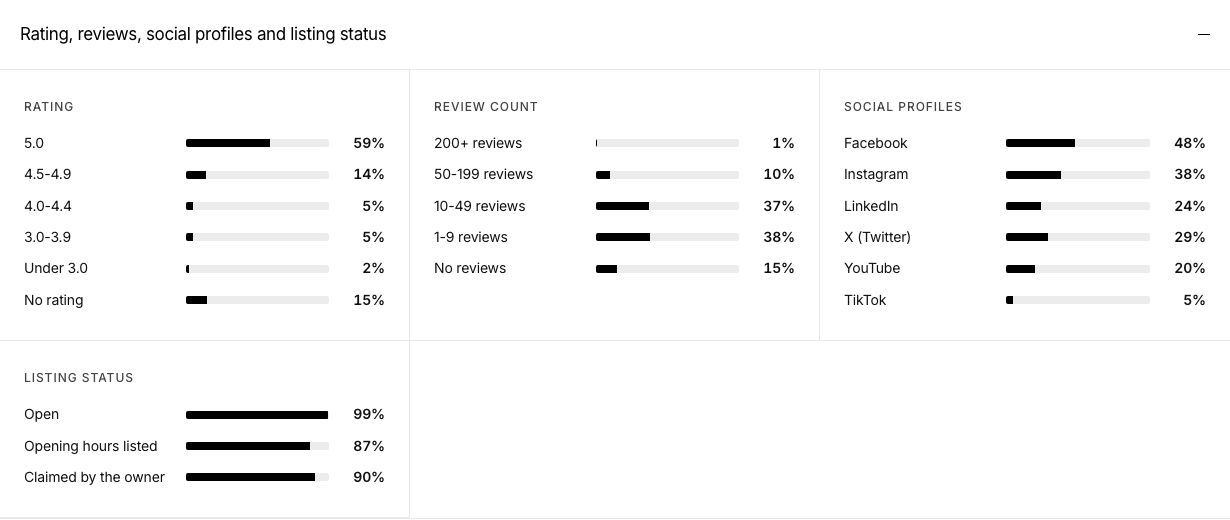
Star ratings tell you much less. Among businesses with at least 10 reviews, where a rating means something, the email rate ranges from 77.7% (4.0 to 4.4 stars) to 85.2% (4.8 to 4.9) with no steady trend, and businesses under 4.0 stars came in at 81.1%. A perfect 5.0 looks worse across the board (72.7%) only because so many 5.0 listings have a handful of reviews. Sort by review count, not by stars.
What it means for targeting
Small and new businesses are often the best buyers for a new vendor: nobody else is calling them yet. They are also the hardest to email. Treat the review count as a routing rule, not a filter.
- 01
Sort the list by review count
Every row in our lists carries the review count, rating and claimed flag, so you can split a file in a spreadsheet in a minute.
- 02
Email the established businesses
At 10+ reviews, 78% to 86% have a usable email and 55% to 65% have two or more addresses, so one bounce doesn't lose the business. Run your sequence here first. Our cold email guide for local businesses covers the copy.
- 03
Call or message the small ones
Under 10 reviews, a third or more have no email, but 88% to 93% list a phone and 41% to 53% have a social profile. Use cold calls and social prospecting.
- 04
Keep unclaimed, unreviewed rows for last
They had the lowest email rate in our data (38.3%), and unreviewed listings were the likeliest to be temporarily closed (1.9% against 0.3% at 10+ reviews). Check them before you spend time on them; our lead list quality checklist covers how.
How we measured. Review counts and ratings come from each business's public map listing on the day we built its list, November 2026. An email counts if it is a real address for that business, found on its website, social pages or a directory, and is not a system inbox such as noreply@. We used only the 323 lists that had been through the full website email search, so a missing email means we searched and found none.
The pattern holds across trades, but the level differs a lot by industry: see which industries publish email addresses. If you want a list already filtered to established businesses, or only to new ones, a Bespoke plan builds it to that brief: $99 a month for 2,000 verified leads. Ready-made lists are $29 once with every row's review count included.