The short answer
Ask for a sample of complete rows and score it on ten checks: email, phone and website fill rates, own-domain versus free-mail emails, duplicates, closed businesses, build date, verification, source and columns. Across our 323 lists the median list has emails for 79% of rows and phones for 96.6%, 79% of emails sit on the business's own domain, and 0.7% of businesses are temporarily closed.
Every lead list vendor says its data is accurate. Few show you a way to check. The good news is that you don't need the whole file to judge it: twelve to fifty honest sample rows, a spreadsheet and fifteen minutes will tell you most of what matters. The hard part is knowing what "good" looks like for small and local businesses, where an email fill rate of 60% can be excellent and 95% can be a red flag. This guide gives you the benchmarks, measured across our own 323 lists, and uses one of our free samples as the worked example.
What good looks like: fill rates from 323 lists
We measured every list we sell. The middle half of our lists (25th to 75th percentile) has an email for 66.9% to 84.6% of rows; the median is 78.8%. Phones are near universal, websites close behind. Use these as your yardstick for any small business list, from any vendor.
Median fill rate per list, across 323 lead lists
Email rates depend heavily on the industry, so compare a list against its own trade, not against a general average. Professionals who win clients online publish emails; trades and shops that live on the phone don't. Which industries publish email addresses has the full ranking.
Share of businesses with an email, by industry
The scored checklist
Score each check out of 10 on the vendor's sample. Total out of 100. Above 80, buy. Between 60 and 79, buy small and test a send first. Below 60, walk away or build the list yourself.
| # | Check | Full marks when | Benchmark from our data |
|---|---|---|---|
| 1 | Free sample of complete rows | You can download real rows in the delivery format, before paying | 12 rows on every list page, as CSV |
| 2 | Email fill rate | Within the industry's normal range; not suspiciously near 100% | Median list 78.8%; all rows 73.5% |
| 3 | Own-domain emails | Most emails match the business's website domain | Median list 79.2% of emails |
| 4 | Free-mail share | Under about a fifth of emails, except trades and agents | Median list 10.7%; all emails 15.5% |
| 5 | Phone fill rate | Above 90% for local businesses | Median list 96.6% |
| 6 | Website fill rate | Above 75% | Median list 84.2% |
| 7 | Duplicates | Under 1% of rows repeat a name and address | 0.08% of rows |
| 8 | Closed businesses | Permanently closed removed; temporarily closed flagged | 0.7% temporarily closed, flagged in business_status |
| 9 | Build date and verification | File date stated; emails checked before delivery | Build date on every page; every email verified |
| 10 | Source and columns | Vendor says where data comes from; address, city, ZIP on every row | Map listings, websites, directories; 100% address and ZIP |
Running the checks on a sample in 15 minutes
- 01
Download the sample, don't just look at it
Open it in a spreadsheet. A sample you can only see as a screenshot can't be checked. Our list pages let you download the 12 rows as a CSV.
- 02
Count fill rates
Use COUNTA on the email, phone and website columns and divide by the row count. Compare with the industry benchmark above.
- 03
Compare email domains with websites
For each row, does the part after @ match the website? Our files do this for you in email_matches_website. Then count gmail.com, yahoo.com and the other free-mail domains.
- 04
Click five websites and two map listings
Is the business real, open and in the right industry? Does the phone on its own site match the file? This is the fastest test of freshness.
- 05
Look for duplicates and branches
Sort by business name and by phone. Repeated names at different addresses are branches (fine if you want them); repeated name and address is a duplicate.
- 06
Send a test, if you can
Run the sample's emails through a verifier, or send a plain note to a few. See how to verify an email list.
Duplicates, branches and closed businesses
Duplicates come in two kinds. A true duplicate is the same business twice, usually from merging two sources; in our files only 0.08% of rows repeat a name and an address, because each row is a distinct map listing. A branch is the same brand at a different address, which is correct data but changes how you count: a list of 1,000 pharmacies might carry one corporate inbox on many branch rows, so count distinct email addresses, not rows with an email, before comparing prices.
Closed businesses are the other silent cost. A list scraped once and resold for two years fills up with them. Ask the vendor whether permanently closed listings are removed and whether temporary closures are flagged. In our files permanently closed listings are dropped at build time, and the 0.7% that are temporarily closed carry CLOSED_TEMPORARILY in the status column so you can filter them out.
Worked example: the Palm Beach County free sample
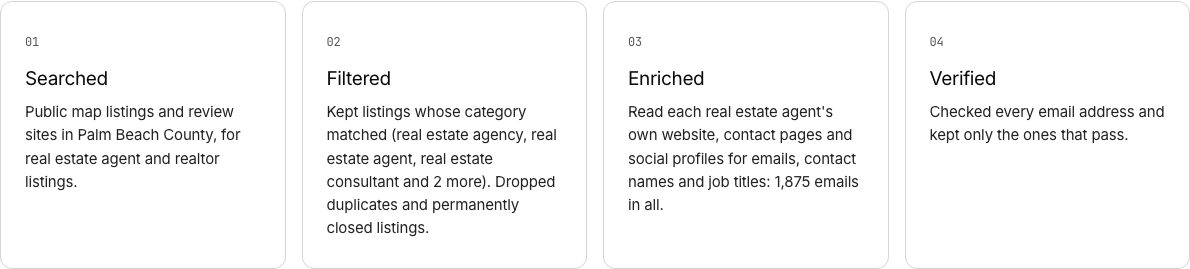
Here is how our own Palm Beach County real estate list scores. The list page shows the counts for the whole file, and the 12 sample rows download as a CSV with the same columns.

Palm Beach County real estate list vs the median of our 323 lists
Palm Beach County real estateMedian list
Phone and website are at or above the median. Email is below it, at the low end of our 20 real estate lists (65.7% to 85.2% of rows), and the own-domain share is well below, at 59.7% of emails. That is normal for the industry, not a defect: many agents work under a brokerage's domain or a personal gmail.com address, and across all our real estate lists 21.3% of emails are free mail. Scored against its own trade, the file earns full marks on checks 2 to 4. On the rest: 12 downloadable rows (10), no row in the whole file repeats a name and address, 12 temporarily closed listings flagged out of 1,590 (0.75%), a stated build date of November 20, 2026, and every email verified. It scores in the 90s.
Questions to ask any vendor
- Can I download sample rows in the delivery format? If not, you're buying blind.
- When was this file built, and how often is it rebuilt? Ask for a date, not "regularly updated".
- Where does the data come from? Map listings, business websites and directories are checkable; "proprietary sources" isn't.
- Are emails verified before delivery, and what happens if they bounce? Get the refund or replacement policy in writing.
- How are chains and branches handled? One row per location or one per brand changes the real count.
- Are closed businesses removed? Permanently closed should be gone; temporarily closed should be marked.
Large B2B databases are built around employees of bigger companies, so run these checks especially hard on their small business records; see LeadLists vs ZoomInfo and LeadLists vs Apollo. If you'd rather scrape and clean yourself, buy vs build a lead list and LeadLists vs Outscraper compare the cost in hours.
Every ready-made list is $29 once, with 12 free rows to score before you pay and a 7-day money-back guarantee. For a list built to your own brief, with every email verified and new matches pushed to your CRM or sending tool, Bespoke Starter is $99 a month for 2,000 verified leads and Pro $199 for 5,000 (pricing).